Can yoga help with stress, anxiety, depression or is it simply a way to become more flexible?
I work with many clients who are stressed and overwhelmed or suffering from anxiety, depression or other mental health challenges in my clinical nutrition practice
I often bring up that I am also a yoga teacher and suggest to many clients how yoga can benefit their nervous system. Many tell me they aren’t flexible enough or need to go to the gym first before starting yoga, missing my point entirely.
Most people, it seems first think of the physical aspect of yoga, but did you know that an Australian study done by Penman et al. showed 58.4% of respondents gave the reason for starting yoga as “reduce stress and anxiety”. It was noted that 79.4% yoga students continued to practice yoga for the benefits of reducing stress and anxiety.
There are many different types of yoga and it can be very confusing where to even start. I am not going to list them all here, but there are quite some differences between the styles in what they offer and provide. Some are quite powerful and very pose driven to create strength and flexibility, which some people may be drawn to that require more active exercise to help manage stress. Some are more subtle in their approach and some can be mixed. My classes are either hatha, yin and restorative yoga. But often when I teach hatha I may include some poses of yin and restorative and often will do some slower flow movements (vinyasa), creating balance in my class for those that are experiencing any type of mental health challenge.
Those experiencing stress and anxiety benefit from certain postures and sequences, whereas those experiencing depression or trauma can benefit from a different approach. My approach in my classes as a Mental Health Aware Yoga Teacher is to teach a balance between these different poses, sequences and breath work which can suit all attending.
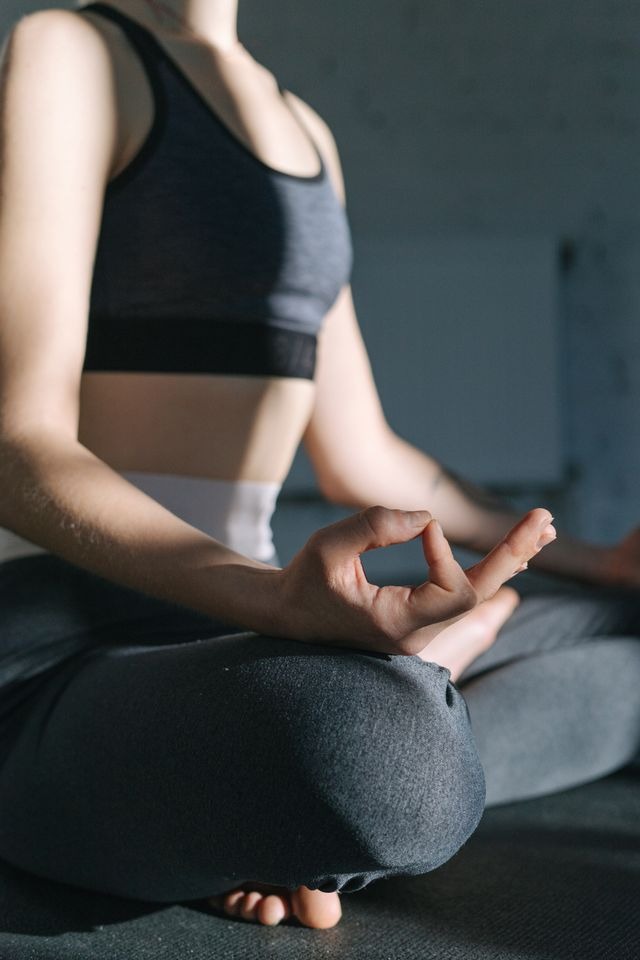
In what ways can yoga help mental health?
The strongest evidence we have so far (there are some limitations to the research) is that stress and anxiety can be reduced with the practice of yoga. I approach this with many clients who are doing cortisol testing and nervous system support work with me in clinic to suggest yoga or similar practices as an adjunct to help to balance their cortisol – their stress hormone. Most people comment after a yoga class how good they feel afterwards.
There have been quite a few studies done (usually on smaller cohorts) showing that yoga can help decrease depression quite significantly.
Yoga can help with PTSD, sleep and chronic pain and medical conditions which can often be a cause of stress and anxiety or depression.
Exercise is known to help with mental health and yoga incorporates movement (some don’t necessarily consider if yoga counts as exercise), but physical movement is still usually involved in a yoga class.
But what else does yoga bring besides movement? It brings connection to oneself and to others, embodiment and awareness of the self, mindfulness, and self-acknowledgment. From the words of my Mental Health Aware Yoga Teacher Dr Lauren Tober says “Yoga, is at its heart, a practice of self-knowledge. Through sustained practice, we may begin to notice patterns of sensation, breath, thought, emotion, behaviour and reactivity.” (Tober 2026). In my yoga classes, I support all students without judgement to feel safe in exploring their self-inquiry.
The way I teach my classes are more focussed on helping those reduce stress and not achieve the perfect yoga pose. I allow students to move at their own pace, taking options for poses that work with their own bodies as I encourage everyone to listen to their body. I don’t go around the class trying to make everyone all look the same with hands-on adjustments, as we are all different and our bodies can’t all do the same shapes. In my hatha class, we’ll do some gentle movements and some more dynamic movements to build strength (meeting each student where they are at with options), there is always breath awareness and awareness of your body incorporated in every class and a component of stretching and relaxation.
I don’t want students to feel stressed about coming to class before they even get there as the sole purpose of why I teach yoga is to hold space for my students with compassion to help ease their stress and anxiety.
If you are interested in finding out more about joining my classes or interested in what hatha, yin and restorative yoga styles are and which might suit your needs, then please reach out for a chat.
*References available upon request
 31/08/2026
 Articles
  0 Comment(s)




Comments
There are no comments yet!